India’s Theatre Deterrence Workhorse
Agni-1 is a single-stage, solid-fuelled, medium-range ballistic missile developed by India’s DRDO, with a confirmed range of 700–1200 km, designed specifically for theatre-level nuclear deterrence.
South Asia’s strategic balance rests on a complex web of missiles, doctrines, and deterrent signals. Right at the centre of India’s land-based nuclear posture sits the Agni-I — not the flashiest system in the inventory, but arguably the most consequential one for day-to-day deterrence.
Here’s why this matters: while longer-range Agni variants dominate international headlines. The Agni-I is the missile that India can actually deploy fastest, disperse most widely, and rely on most consistently. With over two decades of operational service and a test success rate exceeding 90%. It is the battle-proven backbone of the Strategic Forces Command’s theatre-strike capability.
This article covers everything — from propulsion physics and payload specifications to nuclear doctrine, regional strategy, and future upgrades.
What Is the Agni-1 Missile?
Agni-I is India’s indigenously developed medium-range ballistic missile with a 700–1200 km range, capable of carrying conventional and nuclear warheads up to 1,000 kg. It is managed by the Strategic Forces Command and was formally inducted into service in 2004.
Agni-I is India’s most deployable nuclear-capable missile. A statement backed by its solid-fuel readiness, road-mobile basing, and 20+ years of active operational status.

Origins and Programme Background
The missile’s lineage connects directly to the Integrated Guided Missile Development Programme (IGMDP), launched in 1983 under Dr. A.P.J. Abdul Kalam. Rather than being a scaled-down Agni-II, the Agni-I was conceived as a purposefully distinct system — optimised for speed of deployment and theatre-level responsiveness rather than intercontinental ambition. That was a considered design philosophy, not an engineering limitation. In simple terms, India needed a missile it could field quickly, disperse effectively, and maintain reliably. Agni-I was built to be exactly that.
Agni-1 Missile Range: Exactly How Far Does It Reach?
The Agni-1 missile range is officially 700 km to 1,200 km. At maximum payload of 1,000 kg, range approaches the 700 km lower bound. With lighter payloads, the missile reaches its 1,200 km ceiling, classifying it as a Medium-Range Ballistic Missile (MRBM) under international arms control definitions.
With a 700–1200 km range, Agni-1 is precision-optimised for regional deterrence — covering strategic targets across Pakistan’s entire geographic depth from a single launch platform.
Operational Range and Trajectory Mechanics
At its lower payload configuration, the missile carries heavier warheads — up to 1,000 kg — which naturally constrains range. Lighter payload arrangements unlock the full 1,200 km reach. The flight trajectory is steeply ballistic: the missile climbs to altitudes of several hundred kilometres before descending at hypersonic terminal velocities toward the designated aim point. This steep re-entry profile makes interception considerably more challenging for most theatre-level missile defence systems currently deployed in the region.
Full Technical Specifications of the Agni-1 Missile
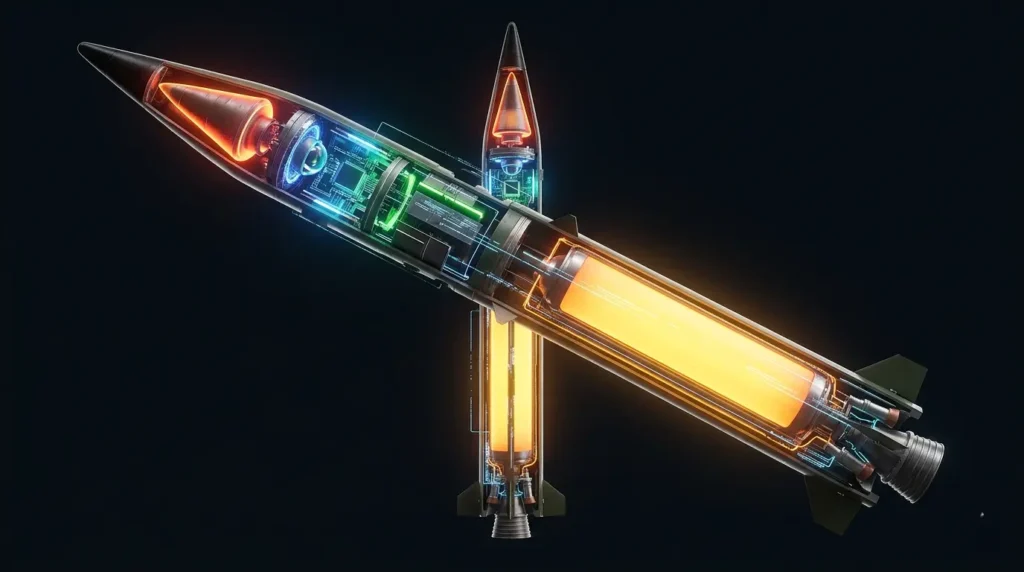
Agni-I measures approximately 15 metres in length, weighs around 12,000 kg at launch, uses single-stage solid-fuel propulsion, and can deliver payloads up to 1,000 kg across a 700–1200 km range envelope.
Physical Dimensions and Airframe
The missile stands approximately 15 metres tall with a body diameter of roughly 1 metre. Its launch weight of approximately 12,000 kilograms is modest by ballistic missile standards — a design choice with deliberate operational consequences. The compact form factor enables loading onto road-mobile transporter-erector-launchers (TELs) with minimal infrastructure requirements, which is operationally invaluable during dispersal operations under threat conditions.
Solid-Fuel Propulsion System
What makes this interesting is that solid propellant — unlike the liquid-fuel systems that dominated Cold War-era ballistic missiles — requires zero pre-launch fuelling. That distinction compresses the preparation timeline from several hours to mere minutes. In a crisis scenario where decision windows are narrow, those minutes are not administrative conveniences. They are potentially decisive strategic advantages. The single-stage motor delivers sufficient thrust to place the warhead on a suborbital ballistic arc before terminal gravity and aerodynamics guide it toward impact.
Payload and Warhead Capability
Agni-1 accommodates payloads of up to 1,000 kilograms, encompassing both conventional high-explosive warheads and nuclear devices. The nuclear variant is assessed to support yields ranging from approximately 15 to 250 kilotons. A range sufficient to hold at risk both soft area targets and semi-hardened military infrastructure. India has not officially disclosed specific yield parameters, maintaining sub-doctrinal strategic ambiguity as a deliberate policy posture.
Guidance, Navigation, and Accuracy
Agni-1 uses a ring laser gyroscope inertial navigation system (INS), with GPS-assisted terminal guidance in upgraded variants, achieving a Circular Error Probable (CEP) of approximately 25–40 metres.
Ring Laser Gyroscope INS
The guidance architecture centres on a ring laser gyroscope-based inertial navigation system. A technology that tracks the missile’s position, velocity, and attitude in real time without external reference signals. This autonomous guidance approach provides inherent resistance to electronic jamming and GPS denial. No adversary can blind the system by interfering with satellite signals. Later variants incorporate GPS/NavIC terminal guidance overlays that sharpen accuracy further, pushing CEP toward the 25-metre end of the performance envelope.
CEP Performance in Context
A CEP of 25 to 40 metres means that at least 50% of warheads land within a circle of that radius around the intended aim point. For a system developed primarily through indigenous engineering, this accuracy benchmark places Agni-I in competitive company internationally. That figure is sufficient to confidently engage hardened military targets, not merely area targets — a significant qualitative capability distinction.
Launch Platforms and Mobility
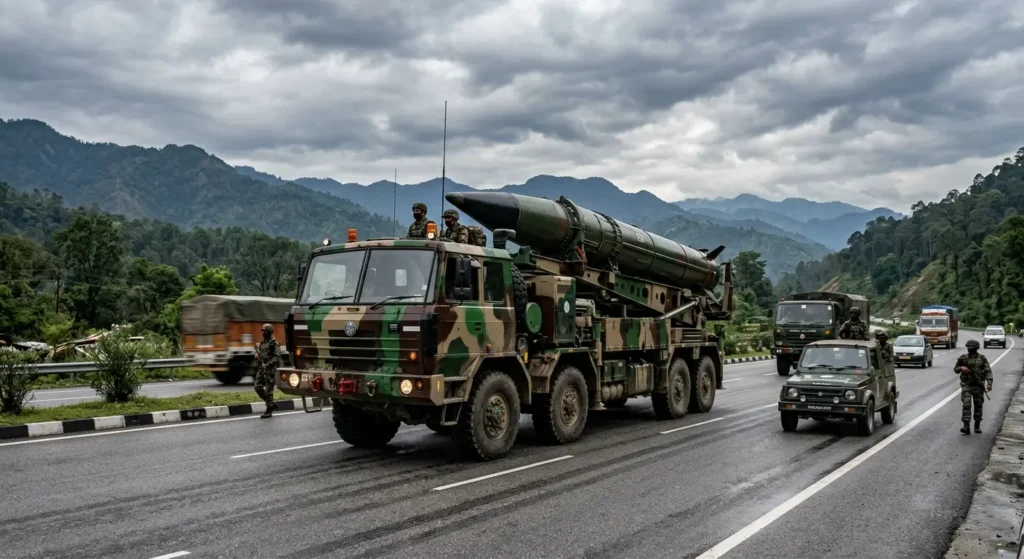
Agni-I can be launched from road-mobile transporter-erector-launchers (TELs) and rail-mobile platforms, giving it a survivable, dispersed basing posture that complicates adversary pre-emption planning.
Road-Mobile TEL Operations
The missile’s road-mobile launch configuration allows strategic units to disperse across India’s 6.3-million-kilometre road network, making comprehensive surveillance and pre-emptive targeting by adversaries practically infeasible. A force that cannot be reliably located cannot be reliably destroyed. That survivability logic is fundamental to why Agni-I’s mobility specification is as strategically significant as its range specification.
Rail-Mobile Basing
Rail compatibility extends the dispersal geometry further. With access to approximately 68,000 route kilometres of Indian Railways track, rail-mobile Agni-1 launchers can reposition across the subcontinent within operational timelines — rendering fixed-site targeting strategies obsolete against a sufficiently dispersed force. Here’s why this matters at the doctrinal level: survivability of the retaliatory force is what gives the No First Use pledge credibility.
Development History: From IGMDP to Operational Readiness
Agni-1 was first successfully tested on 25 January 2002 at Wheeler Island (now Abdul Kalam Island), Odisha. Formally inducted into the Indian Army’s Strategic Forces Command in 2004 — making it one of India’s earliest operationally deployed nuclear-capable ballistic missiles.
Key Test Milestones
The inaugural successful flight on 25 January 2002 marked the transition from development prototype to validated weapons system. Subsequent user trials in 2004, 2007, 2010, 2012, 2015, 2018, 2021, and 2022 progressively confirmed all-weather operability, reliability across payload configurations, and round-the-clock launch readiness. Night-time test launches validated the system’s 24-hour operational credibility. An important doctrinal requirement for a system that may be called upon without advance notice or favourable conditions.
Each test also carried a secondary signalling function. Announcing exercises communicated to regional adversaries that India’s deterrent force maintained active readiness. A message calibrated as much for strategic audiences as for technical validation purposes.
Core Features That Distinguish Agni-1
Agni-I’s defining features include solid-fuel propulsion for rapid launch readiness, multi-modal mobility for survivability, dual-use payload capability for nuclear and conventional missions, and advanced INS guidance delivering 25–40 metre CEP accuracy.
Solid-Fuel Propulsion Advantage of Agni-1 missile
With no need for pre-launch fuelling, no toxic propellant handling, and minimal preparation time, the system offers rapid operational readiness. Solid fuel collapses the launch timeline to minutes — a decisive advantage in compressed crisis scenarios where response speed determines strategic credibility.
Road and Rail Mobility Architecture
The TEL-based road-mobile configuration, reinforced by rail compatibility, creates a dispersed basing posture with no fixed address for adversary targeting systems to lock onto. A missile that cannot be reliably located before launch cannot be reliably pre-empted.
Dual-Use Payload Capability
Accommodating both conventional high-explosive and nuclear warheads gives commanders mission flexibility that pure nuclear delivery systems lack. This dual-use character enables Agni-1 to serve across the full spectrum of conflict intensity — from conventional strikes against hardened targets to nuclear second-strike operations.
Advanced INS Guidance Package
The ring laser gyroscope INS, combined with GPS/NavIC terminal guidance integration, delivers sub-40-metre CEP performance that enables confident engagement of point targets. That accuracy level distinguishes Agni-I from earlier-generation ballistic missiles that were primarily area-effect weapons.
Canisterised Storage Configuration
Later production batches incorporate sealed canister storage. A climate-controlled housing that protects propellant chemistry from temperature fluctuation, humidity, and contamination over multi-year deployment cycles. Canisterisation also enables near-instantaneous deployment by pre-integrating the missile, warhead, and propulsion assembly into a single, handleable unit.
Agni-1 Missile’s Strategic Role in India’s National Defence
Agni-1 serves as India’s primary theatre-level deterrent, covering all of Pakistan’s strategic territory within its 700–1200 km range. While complementing longer-range Agni variants that address deeper strategic targets including China’s southern military districts.
Agni-1 fills the theatre deterrence layer that longer-range Agni variants are simply too large and complex to occupy efficiently — making it irreplaceable rather than merely legacy.
Theatre-Level Deterrence Logic
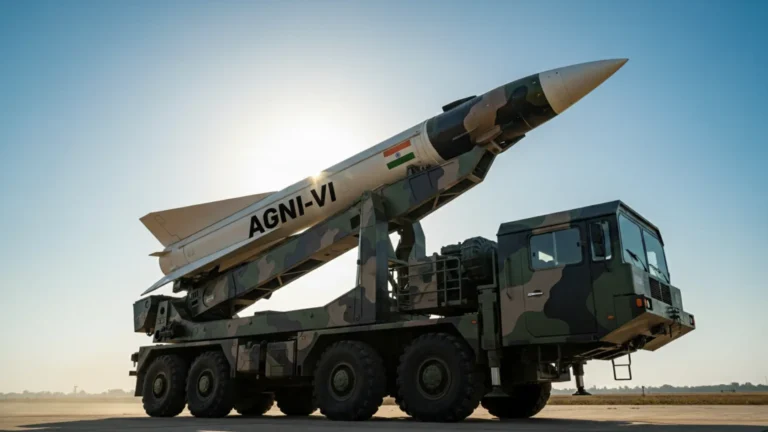
India’s missile architecture spans multiple deterrence layers. Prithvi handles the battlefield short-range role. Agni-II and beyond address deep strategic and intercontinental requirements. The Agni-1 occupies the critical intermediate layer: close enough for genuine theatre-level employment, capable enough to hold major strategic infrastructure at risk. The Agni-VI ICBM currently under development will extend India’s reach to 10,000+ km — but it will not replace the Agni-I’s theatre function.
Agni-1 Missile and India’s Nuclear Doctrine
Under India’s No First Use (NFU) nuclear doctrine, Agni-1 functions as a survivable second-strike retaliatory system. Its road and rail mobility ensures retaliatory capacity survives even a disarming first strike, giving the NFU pledge operational credibility.
No First Use Policy and Second-Strike Survivability
India’s NFU commitment means nuclear weapons are employed only in response to a nuclear attack. For that policy to carry deterrent weight, the retaliatory force must survive a first strike. In simple terms: if the adversary calculates that a first strike can destroy India’s nuclear forces before retaliation, deterrence collapses. Agni-I’s dispersed basing, rapid launch readiness, and 12,000-kg mobility directly counter that calculation. The missile doesn’t need to strike first — it needs to be available and functional when the retaliatory order arrives. Every characteristic of its design serves that singular purpose.
Agni-I missile vs Other Missiles in the Agni Series
Agni-I is a single-stage, 700–1200 km range system optimised for theatre deterrence. Agni-II extends to 2,000–3,000 km across two stages. Agni-V reaches 5,000–8,000 km with ICBM-class capability. Agni-I is the most deployable, most numerous, and fastest-to-launch system in the family.
| Missile | Range | Stages | Launch Weight | Primary Role |
|---|---|---|---|---|
| Agni-I | 700–1,200 km | Single | ~12,000 kg | Theatre deterrence |
| Agni-II | 2,000–3,000 km | Two | ~16,000 kg | Regional deterrence |
| Agni-III | 3,000–5,000 km | Two | ~48,000 kg | Strategic deterrence |
| Agni-IV | 3,500–4,000 km | Two | ~17,000 kg | Advanced deterrence |
| Agni-V | 5,000–8,000 km | Three | ~50,000 kg | ICBM-class deterrence |
The Agni-I’s single-stage architecture makes it the fastest to prepare, easiest to disperse, and most cost-effective to field in large numbers. While Agni-V commands attention for its intercontinental reach. Agni-I is the deployed workhorse of India’s operational nuclear arsenal — numerically dominant and continuously active.
Regional Strategic Balance: Agni-I and the Pakistan Equation
With a 700–1200 km range, the Agni-1 missile covers virtually all of Pakistan’s strategic depth — from Karachi to Peshawar — making it India’s primary theatre deterrent in the western strategic direction.
The geographic arithmetic is unambiguous. Pakistan’s northernmost strategic installations sit well within the Agni-I’s maximum reach. Karachi, Lahore, Rawalpindi, Peshawar — all fall comfortably within the 1,200 km ceiling. What makes this interesting from a strategic standpoint is that India doesn’t need Agni-V’s intercontinental reach to credibly deter Pakistan. The Agni-I does that job entirely — with greater numbers, faster deployment, and lower operational complexity.
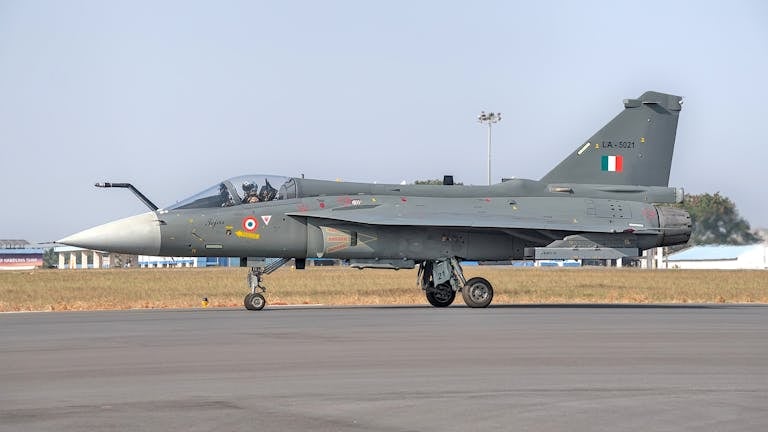
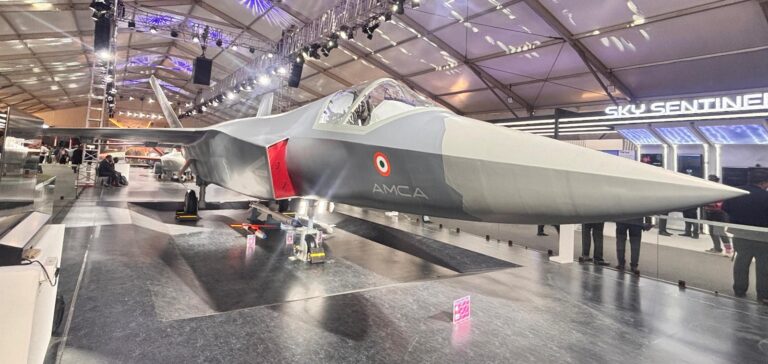
India’s broader defence ecosystem reinforces this deterrent architecture. The Tejas Mk1 aircraft provides a conventional air-power complement that reduces escalatory pressure on nuclear assets. Meanwhile, next-generation platforms like the AMCA stealth fighter will further expand India’s conventional options — reducing the threshold at which nuclear signalling becomes necessary.
Agni-I’s Place Within India’s Integrated Missile Arsenal
Agni-I operates within a layered strategic architecture alongside Prithvi (short-range), BrahMos (precision conventional), K-series SLBMs (sea-based deterrence), and longer-range Agni variants — occupying the critical theatre-level intermediate layer that no other system fills.
The architecture functions as a deterrence continuum. Prithvi covers the battlefield close-in role. BrahMos provides precision conventional strike capability. K-4 and K-15 SLBMs deliver sea-based second-strike survivability. Agni-II through Agni-VI address progressively deeper strategic requirements. Agni-I closes the gap between battlefield and strategic deterrence — a gap that, if left open, would create exploitable escalation space for adversaries. Its position in the architecture is not redundant. It is structural.
MTCR, Export Controls, and International Compliance
India joined the Missile Technology Control Regime (MTCR) in June 2016. As an MTCR member, India is bound by export control obligations that prohibit transfer of Agni-I-class missile technology to third parties without multilateral approval.
With an 800 km+ range and 1,000 kg payload capacity, the Agni-I clearly exceeds the MTCR’s control threshold of 300 km range with 500 kg payload. India’s MTCR membership — formalised after years of negotiations following the 1998 nuclear tests and subsequent sanctions — represents a significant normalisation milestone. The country transitioned from a technology-denied outsider to a full participant in the international non-proliferation governance framework. That transition carries weight in both diplomatic and technology-cooperation dimensions.
Operational Deployments and Recent Test Firings
Agni-I has undergone over a dozen successful test launches since 2002, including confirmed user trials in 2021 and 2022. It is actively maintained by Strategic Forces Command units with demonstrated round-the-clock launch readiness postures.
Tests have been conducted across varying meteorological conditions, payload configurations, and time-of-day windows. Night-time launches, first demonstrated in the mid-2000s, validated the system’s 24-hour operability — a non-negotiable requirement for a deterrent missile. The Strategic Forces Command has progressively standardised its training protocols around Agni-I operations, creating professional expertise pipelines that sustain operational readiness across crew rotations.
Reliability Record and Induction Into the Indian Army
Agni-I has achieved a test success rate exceeding 90% across all known launch attempts since 2002. One of the highest reliability records for any domestically developed ballistic missile in Asia.
A 90%+ success rate is not merely a technical statistic. It is a deterrence credential. An adversary calculating whether India’s retaliatory strike would actually arrive must account for the near-certainty that it will. That reliability removes the probabilistic escape routes that might otherwise encourage risk-taking. The missile was formally inducted in 2004 – just two years after first flight – reflecting confidence in the development programme’s maturity and DRDO’s engineering process rigour.
Agni-1 Missile Future Upgrade Plans and Modernization Roadmap
Potential Agni-1 missile upgrade pathways include NavIC-integrated guidance for sub-10-metre CEP, manoeuvring re-entry vehicle (MaRV) technology to defeat missile defences, improved composite motor casings for weight reduction, and enhanced canisterisation for extended service life.
NavIC Integration in the Agni-1 Missile for Higher Precision
India’s indigenous NavIC satellite navigation constellation — a GPS-equivalent with regional high-accuracy coverage — provides an indigenous positioning reference that eliminates dependence on foreign satellite systems for terminal guidance. Integrating NavIC into Agni-I’s guidance package would push CEP toward single-digit metre performance, enabling engagement of harder targets with greater confidence.
Manoeuvring Re-Entry Vehicle Technology
MaRV-equipped warheads execute aerodynamic manoeuvres during terminal descent, defeating the kinematic intercept predictions that missile defence systems rely upon. Deploying MaRV technology on Agni-I would substantially complicate Pakistan’s HQ-9-based and future missile defence intercept solutions — preserving the system’s penetrability against improving regional air defences.
Composite Motor Casing
Replacing metallic motor casings with advanced composite materials reduces structural mass without compromising propellant volume. The weight saving translates directly into range-payload flexibility — either extending maximum reach or increasing payload capacity at existing range.
Agni-I in the Broader Context of India’s Defence Industrialization
Agni-I’s indigenous development by DRDO under technology-denial conditions established the engineering foundations for India’s entire ballistic missile programme — making it the foundational document of India’s strategic missile industrial tradition.
What makes this genuinely remarkable is the context in which it was achieved. Following India’s 1974 and 1998 nuclear tests, international technology sanctions severely restricted access to foreign propulsion, guidance, and materials technology. DRDO developed Agni-I’s solid propellant chemistry, composite aerostructures, ring laser gyroscope navigation, and re-entry vehicle thermal protection systems substantially from domestic resources and intellectual capacity.
The engineering knowledge accumulated through Agni-I’s development didn’t stop there. It propagated forward into Agni-II, Agni-III, Agni-IV, Agni-V — and will inform the Agni-VI programme currently advancing toward flight testing. Agni-I is therefore not merely a weapon. It is the technological foundation upon which India’s entire strategic missile capability was constructed.
Why Agni-I Remains Strategically Indispensable
In an era of hypersonic gliders and ICBM-class systems grabbing defence media attention, the Agni-I can appear quietly unglamorous. That appearance is strategically misleading.
A 90%+ test success rate. A 700–1,200 km range covering Pakistan’s complete strategic depth. Solid-fuel readiness compressing launch preparation to minutes. Road and rail mobility creating a dispersed, survivable force with no fixed address. Two decades of unbroken operational service. These are not the credentials of a legacy system awaiting retirement. They are the credentials of a mature, proven deterrent that India’s strategic architecture genuinely cannot function without.
Agni-I is India’s most deployable nuclear-capable missile — and in the theatre-level deterrence space, deployability is everything.
While Agni-V and Agni-VI capture the strategic imagination, Agni-I does the actual daily deterrence work. It will continue doing that work for the foreseeable future — upgraded, refined, and more capable with each passing year. But never replaceable in its unique operational niche.
Explore more of India’s expanding strategic capabilities: read our comprehensive analysis of the Agni-VI ICBM. India’s next-generation intercontinental deterrent — discover how the Tejas Mk1 is reshaping India’s tactical air power, or learn how the AMCA stealth fighter will define fifth-generation combat aviation for the Indian Air Force.
Frequently Asked Questions (FAQ)
The Agni-I missile range is 700 km to 1,200 km. Heavier warhead configurations of up to 1,000 kg reduce range toward 700 km. Lighter payload configurations unlock the 1,200 km maximum — classifying it as a Medium-Range Ballistic Missile under international arms control taxonomy.
Yes. Agni-I is designed to deliver both conventional and nuclear warheads. Its nuclear delivery role is managed exclusively by India’s Strategic Forces Command. Under the authority of the Nuclear Command Authority, which operates under the doctrine of No First Use.
Agni-I achieves a Circular Error Probable of approximately 25 to 40 metres under operational conditions — sufficient for confident engagement of hardened military point targets. Later variants with NavIC terminal guidance integration are expected to push this figure below 25 metres.
Agni-I is a single-stage system with 700–1,200 km range and approximately 12,000 kg launch weight — optimised for theatre deterrence and rapid deployment. Agni-II is a two-stage system reaching 2,000–3,000 km with a heavier launch weight of ~16,000 kg — designed for deeper regional strategic targets. The Agni-I is more numerous, more mobile, and faster to launch.
Yes. Agni-I was formally inducted into the Indian Army’s Strategic Forces Command in 2004 and has maintained active operational status for over two decades. Confirmed user trials in 2021 and 2022 verify sustained deployment readiness. More than a dozen successful launches since first flight confirm its status as India’s most battle-proven nuclear-capable ballistic missile.