Introduction: India Is Now Stepping Into the Directed Energy Revolution
India’s DRDO 100kW laser weapon is no longer a distant ambition — it’s about to be tested on a Navy destroyer. And the implications are massive.
For decades, naval combat has revolved around missiles, guns, and torpedoes. That calculus is changing. A weapon that travels at the speed of light, costs nearly nothing per shot, and can engage multiple targets within seconds is moving from laboratory benches to warship decks — and India is now part of that shift.
The Defence Research and Development Organisation (DRDO) is preparing a landmark test of its DURGA-II laser weapon system, designed to operate at 100 kilowatts aboard Indian Navy destroyers. This isn’t just a prototype. It’s the result of years of iterative engineering, strategic investment, and a hard-nosed understanding of the threat environment India must navigate through the rest of this decade and beyond.
This article breaks down everything — the science, the strategy, the global context, and what success here actually means for Indian naval power.
What Is the DURGA-II Program?
Direct Answer: DURGA-II (Directionally Unrestricted Ray-Gun Array, second generation) is India’s flagship naval directed-energy weapon programme, managed by DRDO’s Centre for High Energy Systems and Sciences (CHESS), Hyderabad. It aims to deploy a 100kW shipborne laser weapon on Indian Navy destroyers to defeat drones, missiles, and other aerial threats.
DURGA stands for Directionally Unrestricted Ray-Gun Array. The name itself signals intent: an omnidirectional, scalable laser array built not for a single narrow role, but for broad-spectrum aerial threat engagement. DURGA-II is the second — and substantially more capable — iteration of this programme, succeeding an earlier configuration that focused on lower-power technology demonstrations.
Under DURGA-II, DRDO’s goal is a shipborne high-energy laser capable of defeating:
- Incoming anti-ship cruise missiles at terminal range
- Unmanned aerial vehicles (UAVs) and surveillance drones
- Swarming drone attacks
- Fast-attack craft at close range
What separates DURGA-II from its predecessor isn’t just higher wattage. It introduces enhanced beam quality, improved thermal management, modular power electronics, and a fire-control system designed for actual naval operational tempo. The shift from experimental apparatus to deployable weapon system is precisely what DURGA-II is built to accomplish.
What Is a 100kW Laser Weapon and Why Does It Matter?
Direct Answer: A 100kW laser weapon delivers 100,000 watts of concentrated light energy onto a target, generating temperatures capable of destroying drone airframes in under 3 seconds. At this power level, the weapon becomes operationally effective against both soft and semi-hardened aerial threats.
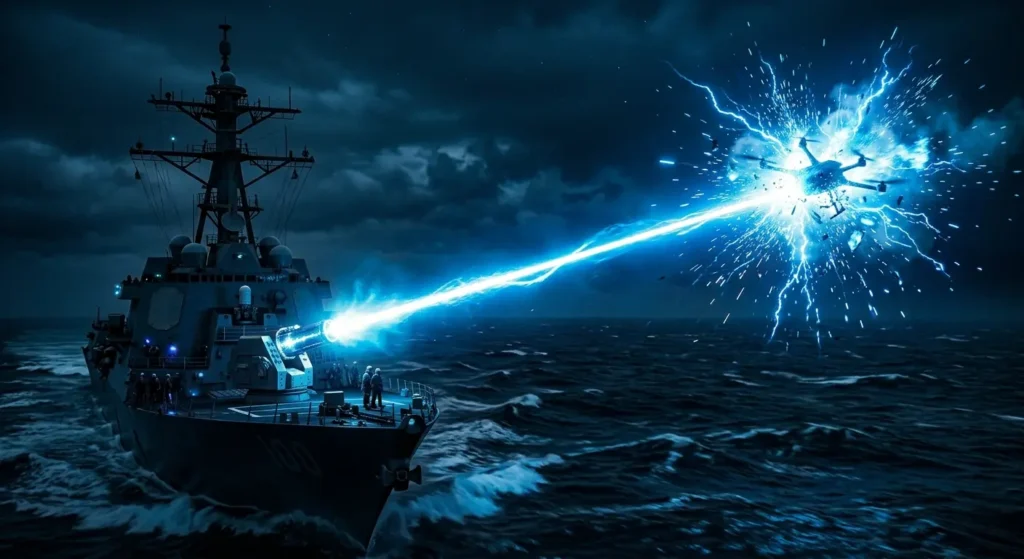
The 100kW threshold is not arbitrary — it’s strategically critical.
- Below ~50kW: Effective against soft targets (optical sensors, thin-skinned UAVs) at short range
- At 100kW: Can burn through composite airframes in under 3 seconds at operationally relevant ranges
- Above 150kW: Begins threatening more hardened threats, including certain cruise missile bodies
At 100 kilowatts — roughly equivalent to 134 horsepower channelled into a coherent, invisible beam — temperatures at the focal point can exceed several thousand degrees Celsius within milliseconds. Materials engineered to withstand physical trauma are essentially defenceless against sustained photothermal ablation at this intensity.
India’s 100kW laser weapon is designed to destroy drones and missiles at the speed of light. That isn’t marketing language. It’s physics. And it changes the economics of naval air defence entirely. Each engagement costs a few dollars in electricity rather than hundreds of thousands for a missile interceptor.
The DRDO configuration reportedly uses a fibre laser architecture — superior in beam quality and electrical efficiency compared to earlier slab or disk laser designs — which is critical when power budgets are shared with propulsion, radar, and communications aboard a warship.
How Does a High-Energy Laser Weapon Actually Work?
Direct Answer: A laser weapon focuses concentrated light energy onto a target surface. The absorbed energy converts to heat, causing structural failure through melting, burning, or detonation of internal components — all within seconds.
The process unfolds across several sequential physics steps:
- Beam Generation — A coherent, low-divergence beam is produced by the laser source
- Atmospheric Propagation — The beam travels to the target, subject to absorption and scattering losses
- Wavefront Correction — Adaptive optics compensate in real time for atmospheric turbulence
- Dwell Engagement — The fire-control system keeps the beam precisely on target as both platform and target move
The naval environment adds layers of complexity: salt spray, corrosive humidity, ship roll and pitch, and electromagnetic interference from onboard radar arrays all create conditions that laboratory systems rarely encounter. Solving each of those problems is what distinguishes a true weapon from a research demonstrator.
Why Indian Navy Destroyers? The Strategic Rationale
Direct Answer: Navy destroyers are selected for the DRDO 100kW laser weapon because they have the power generation capacity, deck space, and computing infrastructure required. They are also India’s primary high-value surface combatants operating in contested maritime environments.
India’s guided-missile destroyers — the Kolkata-class today, the Visakhapatnam-class entering service now — are multi-mission platforms that operate far from shore-based air cover. They defend carrier battle groups, amphibious task forces, and strategic sea lanes. The threat environment they operate in has changed dramatically.
- Anti-ship cruise missiles have proliferated among regional adversaries
- Hypersonic glide vehicles are entering active service
- UAV swarms capable of saturation attacks now represent a credible naval threat
- Conventional close-in weapon systems, with finite magazine capacity, may be inadequate against coordinated multi-vector attacks
A 100kW laser weapon addresses all of these simultaneously. It cannot be exhausted by saturation attack. It engages targets in milliseconds. And on a destroyer with power generation capacity exceeding 30 megawatts, the electrical demands are manageable — unlike on smaller frigate or corvette platforms.
DRDO’s Journey: From DURGA-I to the 100kW DURGA-II Laser Weapon
India’s directed-energy research stretches back further than most public accounts acknowledge. Exploratory laser weapons work within DRDO began in the early 2000s, initially validating basic target-defeating capabilities at short ranges and low power levels. DURGA-I — the first formal programme iteration — reportedly reached beam powers in the 25–50kW range, establishing foundational competency in beam control, thermal management, and power conditioning.
But DURGA-I was fundamentally a technology demonstrator. Its real value was institutional: it trained engineers, identified supply-chain vulnerabilities, built computational models of atmospheric propagation, and established the safety and testing protocols that DURGA-II now inherits. The leap from demonstrator to weapon demands a qualitatively different level of systems engineering — one that accounts for environmental ruggedisation, naval qualification standards, and integration with combat management systems.
DURGA-II was sanctioned with significantly larger resources and a non-negotiable mandate: produce a weapon that physically mounts on a naval vessel, survives the sea environment, and engages real targets under operationally realistic conditions. The forthcoming 100kW test is the direct outcome of that mandate.
The Technology Behind the Beam: Key Components of India’s Laser Weapon System
A shipborne directed-energy weapon at this power class is a tightly integrated system-of-systems. Each subsystem must perform reliably under demanding operational conditions.
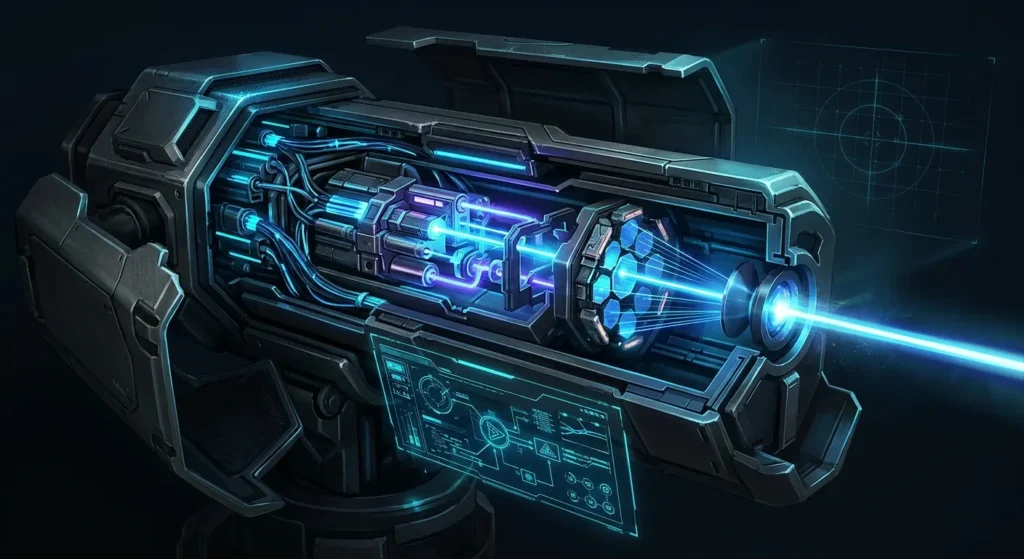
The Laser Source generates the primary beam. In the DURGA-II configuration, individual fibre laser modules — each producing 5–10kW — are likely combined through spectral or coherent beam combining techniques to achieve 100kW aggregate output.
The Beam Director collimates, steers, and focuses the beam on target using large-aperture mirrors and fast-steering mirrors capable of angular adjustments at rates of hundreds of hertz.
The Adaptive Optics System measures and corrects atmospheric distortion in real time via a wavefront sensor and deformable mirror, maintaining beam quality across the propagation path.
The Thermal Management System removes waste heat from gain media and optical components. At 40% wall-plug efficiency, a 100kW laser generates 150kW of waste heat continuously — making thermal architecture arguably the most critical engineering constraint.
The Fire Control System integrates radar tracking, electro-optical/infrared sensors, threat cueing from the ship’s combat management system, and engagement sequencing into a coherent operational loop with sub-second response times.
Thermal Management: The Invisible Engineering Challenge
This is where many high-energy laser programmes stall — and it’s where DRDO has reportedly made significant progress.
A 100kW laser system at 40% efficiency produces 150kW of waste heat continuously during operation. Remove that heat inadequately, and beam quality degrades, optical coatings fail, or the system shuts down mid-engagement. None of those outcomes are acceptable on a warship.
DRDO’s thermal architecture reportedly combines liquid cooling loops, heat exchangers interfaced with seawater (an effectively infinite thermal sink for naval platforms), and phase-change buffer materials that absorb transient heat spikes during rapid-fire engagement sequences. The thermal management design directly determines the system’s sustained firing rate — the duty cycle — which is the critical operational parameter that separates a laboratory curiosity from a combat asset.
Target Engagement: What Threats Can the 100kW Laser Weapon Defeat?
Direct Answer: At 100kW, laser weapons can neutralize UAVs within seconds, disrupt subsonic anti-ship cruise missiles at terminal range, and blind or disable optical sensors on adversary platforms.
Primary engagement scenarios include:
- Anti-UAV operations — Disabling or destroying drones used for over-the-horizon targeting, reconnaissance, or swarming attacks; the highest-frequency near-term use case
- Cruise missile terminal defence — Providing an additional intercept layer against subsonic anti-ship missiles beyond what gun and missile systems can reliably handle under saturation conditions
- Fast attack craft neutralisation — Blinding or disabling propulsion and sensor systems on small, agile surface threats
- Optical payload disruption — Neutralising intelligence-gathering payloads on adversary surveillance platforms without kinetic engagement
- Anti-radiation missile defeat — Potentially engaging missiles homing on the ship’s radar emissions
The layered nature of the Indian Navy’s air-defence architecture means the laser weapon supplements — rather than replaces — existing missile and gun-based systems, filling a specific niche where cost per engagement and sustained fire rate matter most.
How India’s DRDO 100kW Laser Compares to Global Systems
| Country | System | Power Level | Platform |
|---|---|---|---|
| USA | HELIOS | 60–150kW | Navy destroyers |
| USA | LWSD | ~150kW | USS Portland |
| Israel | Iron Beam | ~100kW | Ground-based |
| China | Undisclosed | Estimated <100kW | Naval platforms |
| India | DURGA-II | 100kW | Navy destroyers |
India’s DRDO 100kW laser weapon, when fielded, places India broadly on par with the leading cohort of directed-energy developers globally. That’s a remarkable position for a programme that operated with considerably more constrained budgets than its American or Chinese counterparts. It reflects the maturation of India’s indigenous defence technology base and demonstrates that high-end directed-energy capability is no longer the exclusive domain of the world’s largest defence economies.
Integration Challenges: Mounting a Laser Weapon on a Navy Destroyer
Placing a 100kW laser on a destroyer is a systems integration challenge of considerable complexity. Several concurrent engineering problems must be resolved simultaneously:

- Deck real estate must be allocated without compromising existing sensor arcs or weapon fields of fire
- Power draw must be managed from the ship’s electrical network without degrading propulsion or combat systems during simultaneous engagement
- Structural mounts must isolate the weapon from ship vibration while enabling rapid target slewing
- Cooling loops must interface with the ship’s chilled water infrastructure
- Software integration must connect the laser’s fire control with the Indian Navy’s combat management framework — itself running on indigenous systems developed by Bharat Electronics Limited (BEL) and DRDO’s Centre for Artificial Intelligence and Robotics (CAIR)
None of these challenges are technically insurmountable. But each demands careful, iterative resolution — which is precisely what the forthcoming test campaign is designed to address systematically.
Power Supply and Energy Storage for Shipborne Laser Systems
Firing a 100kW laser demands precisely conditioned power with minimal voltage ripple. Transient demands during beam initiation can stress shipboard power distribution systems in ways conventional loads simply do not.
DRDO’s solution reportedly incorporates dedicated power conditioning units alongside pulsed power storage — either ultracapacitor banks or flywheel energy storage systems — that supply clean, high-current bursts during engagement without burdening the ship’s main generators. This also enables a burst engagement mode: delivering higher instantaneous power than steady-state output for scenarios where peak irradiance matters more than sustained firing duration.
The Role of Adaptive Optics in India’s DURGA-II Laser Weapon
The maritime atmosphere is particularly hostile to laser propagation. High humidity, thermal gradients above the sea surface, and salt aerosol scattering all degrade beam quality across propagation paths. Without real-time correction, a pristine 100kW beam that leaves the director with excellent characteristics can arrive at the target significantly weakened.
DURGA-II’s adaptive optics system must operate at bandwidths of several kilohertz — correcting wavefront aberrations continuously — to compensate for rapidly varying maritime turbulence. The wavefront sensor samples a reference beacon, and the deformable mirror applies pre-compensatory corrections before distortions accumulate across the propagation path.
This is the same physics used by the world’s leading astronomical observatories. DRDO has adapted that science for the adversarial context of naval combat — a testament to the genuine depth of India’s photonics and electro-optical research community.
DRDO’s Collaborative Ecosystem Behind DURGA-II
DURGA-II is not the product of a single laboratory. It emerges from a distributed network of institutions working in coordinated parallel:
- CHESS Hyderabad — Core laser source and beam control research
- DIAT Pune — Systems engineering and naval qualification support
- IITs and IISc — Photonics, adaptive optics, and power electronics research contributions
- BEL and private-sector partners — Precision optics, high-power electronics, and manufacturing scale-up under the Atmanirbhar Bharat initiative
This collaborative model has compressed development timelines and built an industrial base capable of sustaining the programme through production. It also distributes technical risk: no single point of failure can halt the programme.
Geopolitical Implications: Why India Needs This Capability Now
India’s strategic neighbourhood has never been more demanding. Pakistan has invested heavily in ballistic and cruise missiles, several nuclear-capable. China has built extensive anti-access/area-denial capabilities — anti-ship ballistic missiles, long-range cruise missiles, growing undersea forces — and has aggressively expanded UAV deployment for both reconnaissance and offensive purposes.
India’s DRDO 100kW laser weapon substantially complicates the targeting calculus for both adversaries. Saturation attacks — deploying large numbers of lower-cost munitions to overwhelm point defence — become far less viable against a system with near-unlimited magazine depth and sub-second engagement cycles.
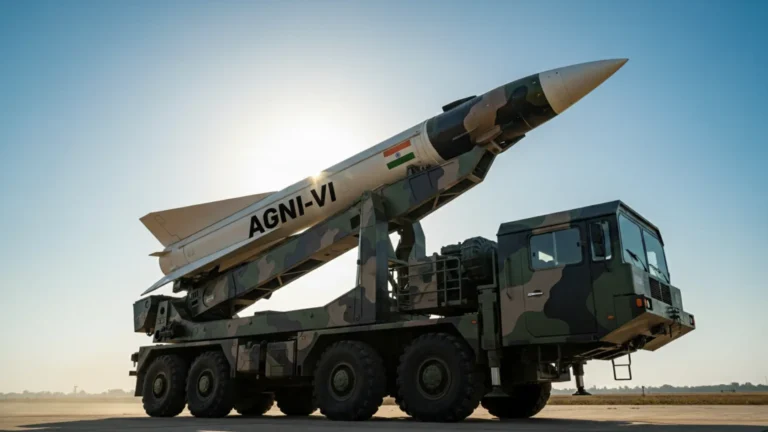
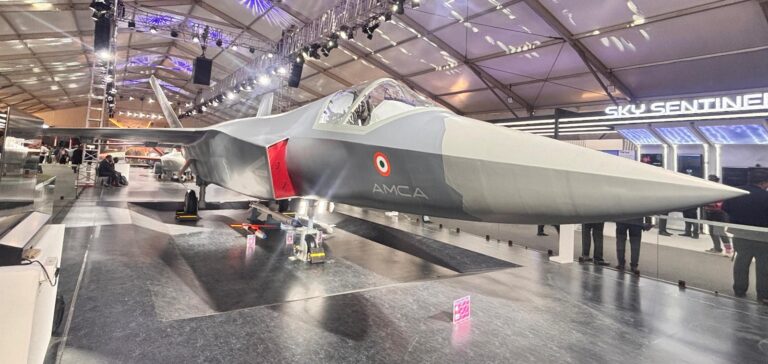
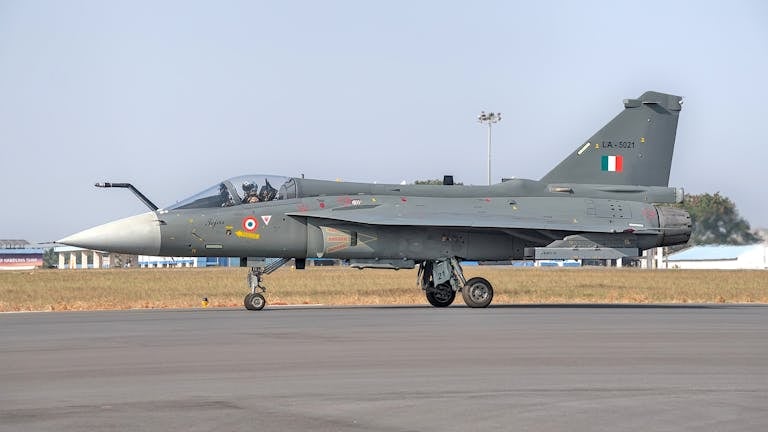
This capability aligns directly with India’s broader programme of sovereign, high-end military development — including the Agni-VI ballistic missile at the strategic deterrence end, the Tejas Mk1 fighter aircraft for air superiority, and the AMCA fifth-generation stealth jet for future dominance. DURGA-II fits into a coherent strategic architecture, not an isolated project.
Foreign suppliers are either unavailable or unwilling to transfer directed-energy technology. India is building it anyway. That tells you everything about where this nation’s defence ambitions are pointed.
Budget Allocation and Programme Timeline for DURGA-II
Precise financial figures for DURGA-II remain classified, consistent with standard Indian practice for sensitive programmes. Informed assessments suggest total investment in the hundreds of crore rupees for the current development phase, with significantly larger allocations anticipated if test trials validate performance parameters and a naval acquisition decision follows.
The test campaign is expected to proceed in two stages:
- Static land-based trials — validating beam quality, power output, and thermal performance under controlled conditions
- Shipboard integration tests — conducted aboard a designated test vessel in a restricted maritime zone
If trials succeed on the projected timeline, initial operational capability on frontline destroyers could follow in the latter half of this decade — a realistic and consequential milestone.
Testing Protocols and Safety Frameworks
Directed-energy weapons testing demands safety frameworks qualitatively different from conventional munitions testing. A 100kW laser beam causes instant, permanent ocular damage at ranges of several kilometres. Unprotected skin and organic material ignite at closer distances. Aircraft within line-of-sight face catastrophic risk from accidental irradiation.
DRDO’s test programme will operate within restricted maritime zones with coordinated airspace exclusions and sea-lane closures. Personnel on and near the test platform will use specialised protective equipment and follow strict procedural controls derived from international laser safety standards. The fire-control system incorporates hardwired engagement interlocks that prevent beam activation if the propagation path intersects friendly platforms, civilian air corridors, or inhabited coastlines.
The Indian Navy has deep institutional experience coordinating complex, multi-agency maritime trials. That experience is a genuine operational asset for a programme of this sensitivity.
The Road Beyond 100kW: Future Upgrades
One hundred kilowatts is a threshold, not a ceiling. At 100kW and beyond, laser weapons can neutralise a wide range of aerial threats. But the physics of fibre laser beam combining and spectral combining scale relatively gracefully — more modules, improved combining efficiency, and enhanced adaptive optics can push output toward 300kW, 500kW, and beyond.
At higher power levels:
- Hardened re-entry vehicles become vulnerable with sufficient dwell time
- Hypersonic glide vehicles — currently resistant to all intercept systems — may become addressable with megawatt-class systems
- Airborne or space-based platforms could engage threats across dramatically larger areas
DRDO has explicitly described DURGA-II as a stepping stone toward higher-power configurations. The institutional knowledge, supply chain, and test infrastructure being built around the 100kW programme form the foundation for subsequent generations. Exactly as DURGA-I established the base for DURGA-II.
The trajectory is clear. India is not stopping at 100kW.
FAQ: DRDO 100kW Laser Weapon and DURGA-II
DURGA-II (Directionally Unrestricted Ray-Gun Array, second generation) is India’s flagship naval directed-energy weapon programme, managed by DRDO’s CHESS laboratory in Hyderabad. It is developing a 100kW shipborne laser weapon for Indian Navy destroyers to defeat drones, missiles, and other aerial threats.
Unlike missiles or guns, a 100kW laser weapon engages targets at the speed of light, requires no physical ammunition, and costs only a few dollars per shot. It cannot be exhausted by saturation attack — which is precisely why it matters so much as a complement to existing naval air-defence systems.
No. The United States has had operational naval laser weapons since the early 2010s. China, Israel, and the UK have active programmes too. But India’s DRDO 100kW naval laser would place it firmly in the top tier of global directed-energy developers — a major milestone for a programme built with indigenous resources.
At 100kW, laser weapons can neutralise UAVs within seconds, disrupt subsonic anti-ship cruise missiles at terminal range, and blind or disable optical sensors on adversary platforms. The DURGA-II system serves as a cost-effective, high-capacity complement to missile-based intercept systems.
No official timeline has been publicly confirmed. If test trials succeed on schedule, initial operational capability on frontline destroyers could follow in the latter half of the 2020s — subject to naval qualification, budget allocation, and production ramp-up.
India’s Laser Weapon Future Is Real
India’s DRDO isn’t just building a weapon — it’s staking a claim to the future of naval warfare. And that future is arriving faster than most people realise.
The DRDO 100kW laser weapon being tested under the DURGA-II program is the culmination of decades of sustained directed-energy research. A maturing defence-industrial ecosystem, and a genuinely clear-eyed assessment of the threats India faces at sea. When this system eventually integrates aboard Indian Navy destroyers, those platforms become something qualitatively different — warships that engage aerial threats at the speed of light, without ever exhausting their magazines, at a cost per shot that makes saturation attacks economically absurd for any adversary.
That is a first-order strategic advantage. And India is building it domestically.
Stay ahead of India’s defence technology story. Explore related coverage on the Agni-VI ICBM programme, the Tejas Mk1 fighter aircraft, and the AMCA fifth-generation stealth jet to understand the full scope of where India is heading. Subscribe to our newsletter — because the next milestone in DURGA-II’s journey may come sooner than expected.